
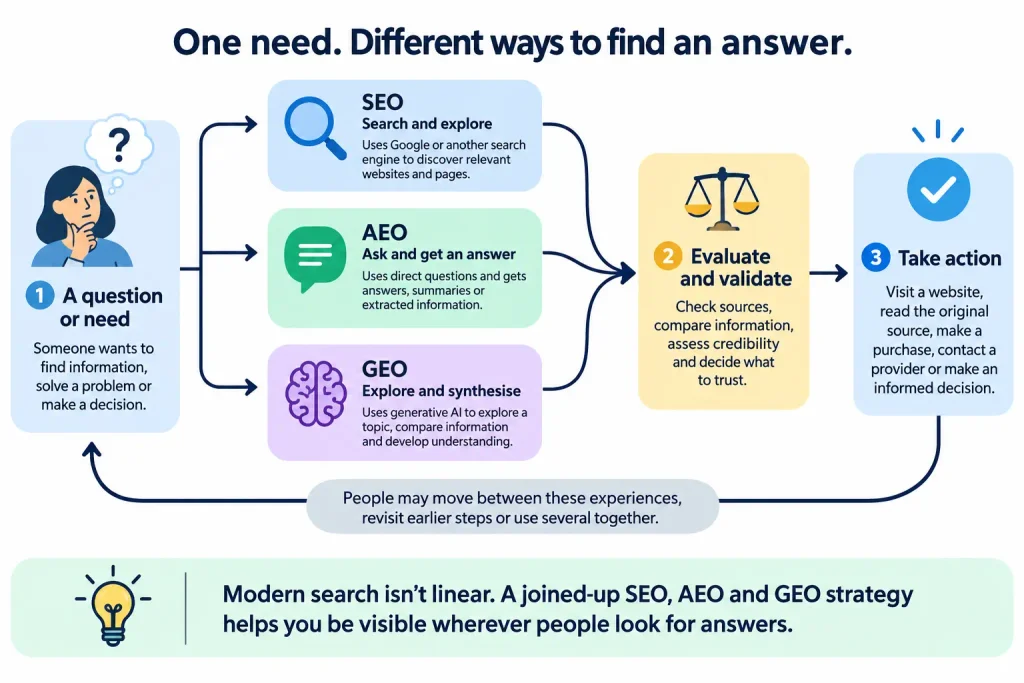
SEO has been part of digital marketing for decades. More recently, two other terms have become common: Answer Engine Optimisation (AEO) and Generative Engine Optimisation (GEO).
Both reflect changes in how people search for information. Instead of always browsing a list of websites, people can now ask questions and receive direct answers from search engines and AI tools.
This has led to an important question: do businesses need separate strategies for SEO, AEO and GEO?
In short, no. The three disciplines have different areas of focus, but they share many of the same foundations. Rather than treating them as separate activities, businesses should bring them together in one search strategy.
To understand why, it helps to look at what each term means and where the differences lie.
What are SEO, AEO and GEO?
Although the terms are often discussed together, they describe different ways of improving how information is found and used.
Search Engine Optimisation (SEO)
SEO focuses on improving a website’s visibility in unpaid search results. The aim is to help the right people find relevant pages when they search for information, products or services.
This involves several areas of work, including:
- Making sure search engines can access and understand a website.
- Creating useful content that matches what people are searching for.
- Organising pages so visitors and search engines can find related information.
- Building the website’s reputation and credibility.
- Providing a good experience across different devices.
SEO covers more than improving rankings for individual keywords. It helps people find useful information throughout their search journey.
Answer Engine Optimisation (AEO)
AEO focuses on making information easy for search engines and other tools to understand and use when responding to questions.
This includes featured snippets, voice search results and AI-generated answers within search experiences.
For example, someone searching for “How does conversion rate optimisation work?” may want a straightforward explanation rather than a list of consultancy websites.
A page that answers the question directly, explains the subject accurately and provides useful supporting information is easier for an answer engine to draw upon.
Generative Engine Optimisation (GEO)
GEO focuses on improving the chances of a business, website or its content being mentioned or cited in answers generated by AI tools.
These include ChatGPT, Claude, Perplexity, Gemini and Google’s AI search features.
For example, someone might ask ChatGPT to recommend a conversion rate optimisation consultancy. The response could include businesses, explain their services and refer to information from different websites.
GEO considers how a business and its information are represented across these sources, not just how individual pages appear in traditional search results.
How do SEO, AEO and GEO overlap?
The three disciplines share many of the same foundations. Search engines and AI tools need to find information, understand what it means and assess whether it is useful.
That makes several established SEO practices relevant to all three.
1. Clear, useful content
Content needs to answer the questions people are asking and explain subjects in a way that is easy to follow.
For example, a page about conversion rate optimisation should explain what it means, why it matters and how it works. A vague introduction followed by paragraphs of general marketing language gives readers little to work with.
Clear explanations also make it easier for search engines and AI tools to identify the information a page contains.
2. Well-organised pages
Headings help readers find the information they need and help search engines understand how a page is organised.
A heading such as “How customer relationship management software works” tells readers more than a vague heading such as “The benefits”.
Pages should follow a logical structure, with headings that describe the information beneath them. This is useful for people reading the page and for tools trying to interpret its content.
3. Understanding what people are looking for
A search query can have different meanings depending on the words used and the reason behind it.
Someone searching for “what is marketing automation?” is likely looking for an explanation. Someone searching for “marketing automation software comparison” is probably evaluating different products.
Content should reflect these differences. A product page, an explanatory article and a comparison guide each serve a different purpose.
Understanding the reason behind a search remains important whether someone uses Google, asks an AI tool or searches within another platform.
4. Expertise and credibility
People need to trust the information they find, particularly when it relates to important business decisions.
Content should demonstrate genuine knowledge of its subject. This might include explaining how something works, sharing original research, providing useful examples or drawing on relevant professional experience.
A website’s reputation also matters. Independent publications, industry websites, reviews and other credible sources can help establish how a business is regarded beyond its own website.
5. Technical website quality
Search engines need to access and understand website content. A well-maintained website also gives visitors a better experience.
Important technical foundations include:
- Site speed and performance: pages should load quickly and work reliably, including on mobile devices.
- Crawlability and indexability: search engines need to access important pages and understand which versions should appear in search results.
- Internal links: links between related pages help visitors and search engines find information across the website.
- Mobile usability: pages should work well across different screen sizes.
- Accessible content: important information should be available as readable text, rather than being hidden in images or inaccessible page elements.
- Structured data: relevant markup can help search engines interpret specific types of content.
These are established practices of good website management. They are not a separate set of requirements for GEO.
Where do SEO, AEO and GEO differ?
Although the foundations overlap, the search experiences they address are not identical. Understanding these differences helps explain why businesses may need to adapt their approach.
Traditional search results and direct answers
Traditional search usually presents a list of links. People can compare websites, visit different pages and decide which information is most useful.
AEO places more emphasis on providing information that can be used to answer a question directly. This may mean appearing in a featured snippet or having content included in an AI-generated answer within a search results page.
This can change the relationship between a search and a website visit. Someone may get the information they need without clicking through to a website.
Being mentioned in AI-generated responses
GEO considers how AI tools select and present information when generating responses.
These tools may draw on several sources, combine information and name businesses or websites in their answers. As a result, visibility is not limited to whether a particular page appears in a list of search results.
A business may need to consider how it is described on its own website and how it is represented elsewhere, including in industry publications, reviews and other relevant sources.
This is a reason why reputation and credible third-party information are important considerations for GEO.
Does GEO replace SEO?
No. Traditional search remains an important way for people to discover websites, products and services. SEO also provides many of the foundations that help search engines and AI tools find and understand information.
Google has explained that its AI Overviews and AI Mode use the same underlying Search infrastructure. Its guidance does not require special technical optimisation or a separate type of schema to appear in these features.
However, this should not be taken to mean that good Google rankings guarantee a place in answers from ChatGPT, Claude or other AI tools. Each platform works differently, and there is no single approach that guarantees inclusion.
The practical point is that businesses should continue to invest in SEO while considering how people are using other search and discovery tools.
Do businesses need separate SEO, AEO and GEO strategies?
No, because creating three separate strategies would lead to unnecessary duplication and additional strain on maintaining that content.
The same website, content and reputation influence all three areas. Useful content attracts organic search visitors, provides information for a direct answer and becomes a source for an AI-generated response.
The better approach is to bring the disciplines together while recognising where additional work is needed.
| Area of work | How it supports search visibility |
| Website content | Helps people find useful, relevant information and gives search tools material to understand and reference. |
| Technical SEO | Makes it easier for search engines to access and interpret website content. |
| Website structure | Helps people and search tools navigate related information. |
| Expertise and reputation | Gives people more reasons to trust a business and its information. |
| External coverage and mentions | Helps establish how a business is represented beyond its own website. |
| Understanding search behaviour | Helps identify the questions people ask and the information they need. |
The balance will depend on the business, its audience and the way people search for its products or services. A company selling specialist software, for example, may need detailed product information, comparison content and independent reviews. A professional services firm may place greater emphasis on demonstrating expertise and building a strong reputation in its field.
The strategy should reflect those needs rather than follow a fixed list of SEO, AEO and GEO activities.
What should businesses focus on?
A practical starting point is to review the existing website and search activity before creating new work.
The following priorities provide a useful direction:
- Review technical SEO foundations. Check that important pages can be accessed and indexed, pages load well, and the site works across devices.
- Improve important content. Make sure key pages answer relevant questions, explain services or products accurately and give visitors enough information to make informed decisions.
- Show genuine expertise. Include useful detail, original insights and relevant experience rather than relying on generic content.
- Build a credible presence elsewhere. Consider relevant industry publications, professional communities, reviews and other sources that help people understand and assess the business.
- Keep up with changes in search. Look beyond traditional rankings to understand where audiences are finding information and how their search habits are changing.
How to measure the results of this work is another important part of the discussion, particularly as visibility in AI-generated answers does not always lead to a website visit. This deserves a closer look in a separate article.
SEO, AEO and GEO describe different aspects of search, but they do not need to operate as separate strategies.
Strong technical foundations, useful content, clear explanations and a credible reputation remain important. The main change is that businesses now need to consider a wider range of places where people discover and assess information.
A joined-up approach allows businesses to build on their existing SEO work while adapting to new ways of searching, without duplicating effort or chasing every new term that appears.
Frequently asked questions
Is GEO just another name for SEO?
No. SEO focuses on improving visibility in traditional search results, while GEO focuses on how businesses and their information appear in AI-generated responses. They overlap because both depend on useful content, accessible websites and credibility.
Is AEO part of SEO?
AEO is closely related to SEO, but places greater emphasis on providing information that can be used to answer questions directly. Many established SEO practices also support AEO.
Does SEO help with visibility in ChatGPT?
Good SEO foundations help make website content accessible and understandable, but strong search rankings do not guarantee that ChatGPT will mention or cite a website. AI tools use different methods to produce their responses.
Does GEO replace traditional SEO?
No. People continue to use traditional search engines to find information, products and services. SEO remains important, while GEO addresses the additional ways people discover information through AI tools.
Do backlinks still matter for GEO?
Links remain useful for SEO and can help people discover a website. References and mentions from credible sources may also contribute to how a business is understood and represented elsewhere. However, there is no universal link-building formula that guarantees AI citations.
Does structured data help with GEO?
Structured data helps search engines interpret information on a page. It should be used where it accurately describes the content, rather than added in the expectation of a particular GEO result.